01 / DYESThe five dyes you’ll see most.
Synthetic food dyes add colour and nothing else. They’re common in candy, drinks, cereals, frostings and snack foods. Each one has several names: a US name (Red 40), a chemical or common name (Allura Red AC), an EU number (E129) and, in cosmetics, a colour index number (CI 16035).
Every one of these has an acceptable daily intake (ADI) set by the European Food Safety Authority (EFSA) — the amount it considers safe to eat every day for a lifetime.
02 / EVIDENCEWhat the Southampton study did — and didn’t — show.
Most of the concern about food dyes traces back to one trial, published in The Lancet in 2007 by researchers at the University of Southampton.
What it did. It was a randomised, double-blind, placebo-controlled trial in 153 three-year-olds and 144 children aged eight and nine from the general population. Children drank juice containing the preservative sodium benzoate plus one of two mixes of artificial colours, or a placebo. Teachers, parents and observers rated their behaviour.
What it found. Mix A increased hyperactive behaviour in the three-year-olds compared with placebo; mix B did not. In the older children, both mixes had an effect among those who drank at least 85% of the drinks. The effects were small — effect sizes between 0.12 and 0.32.
What it didn’t show:
- It tested mixtures, always together with sodium benzoate, so it can’t say which colour — if any single one — caused the effect.
- It measured behaviour scores in ordinary children. It didn’t diagnose or study ADHD.
- It didn’t find an effect in every group: mix B had no significant effect in the three-year-olds.
EFSA reviewed the study and concluded that its findings couldn’t be used to change the ADIs of the colours. The EU nonetheless requires a warning label on foods that contain six of them.
The evidence supports a small effect in some children, from mixtures. It doesn’t support the idea that one dye causes ADHD.
03 / RULESHow the rules differ.
- European Union — since 20 July 2010, foods containing sunset yellow (E110), quinoline yellow (E104), carmoisine (E122), allura red (E129), tartrazine (E102) or ponceau 4R (E124) must state the colour’s name or E number followed by: “may have an adverse effect on activity and attention in children.” Drinks over 1.2% alcohol are exempt. Erythrosine (E127) is allowed only in cocktail cherries, candied cherries and Bigarreaux cherries.
- United States — Red 40, Yellow 5, Yellow 6 and Blue 1 remain authorised, and every batch must be certified by the FDA. Certified colours must be named on the label (for example “Red 40” or “Blue 1 Lake”). The FDA has revoked Red 3 for food from January 15, 2027, and for ingested drugs from January 18, 2028. In April 2025, the FDA also asked industry to remove six synthetic dyes — including Red 40, Yellow 5, Yellow 6 and Blue 1 — by the end of 2026. That request is voluntary; it doesn’t revoke their authorisation.
- Canada — all five are on Health Canada’s List of Permitted Colouring Agents, but only for listed foods. The usual limit is 300 ppm for one colour or for a combination, with brilliant blue (and fast green) capped at 100 ppm; some foods have their own limits. Canada doesn’t require an EU-style warning.
Required on foods with any of six colours, including Red 40, Yellow 5 and Yellow 6.
The usual cap for synthetic colours in listed foods, alone or combined.
On Red 3, the FDA was clear about its reasons: high doses caused cancer in male rats through a hormonal mechanism seen in male rats — studies in other animals and in people haven’t shown the same effect — and the Delaney Clause bars any colour shown to cause cancer in animals. The FDA says there’s no evidence it causes cancer in humans. EFSA has kept its ADI, considering the rat thyroid tumours of limited relevance to humans.
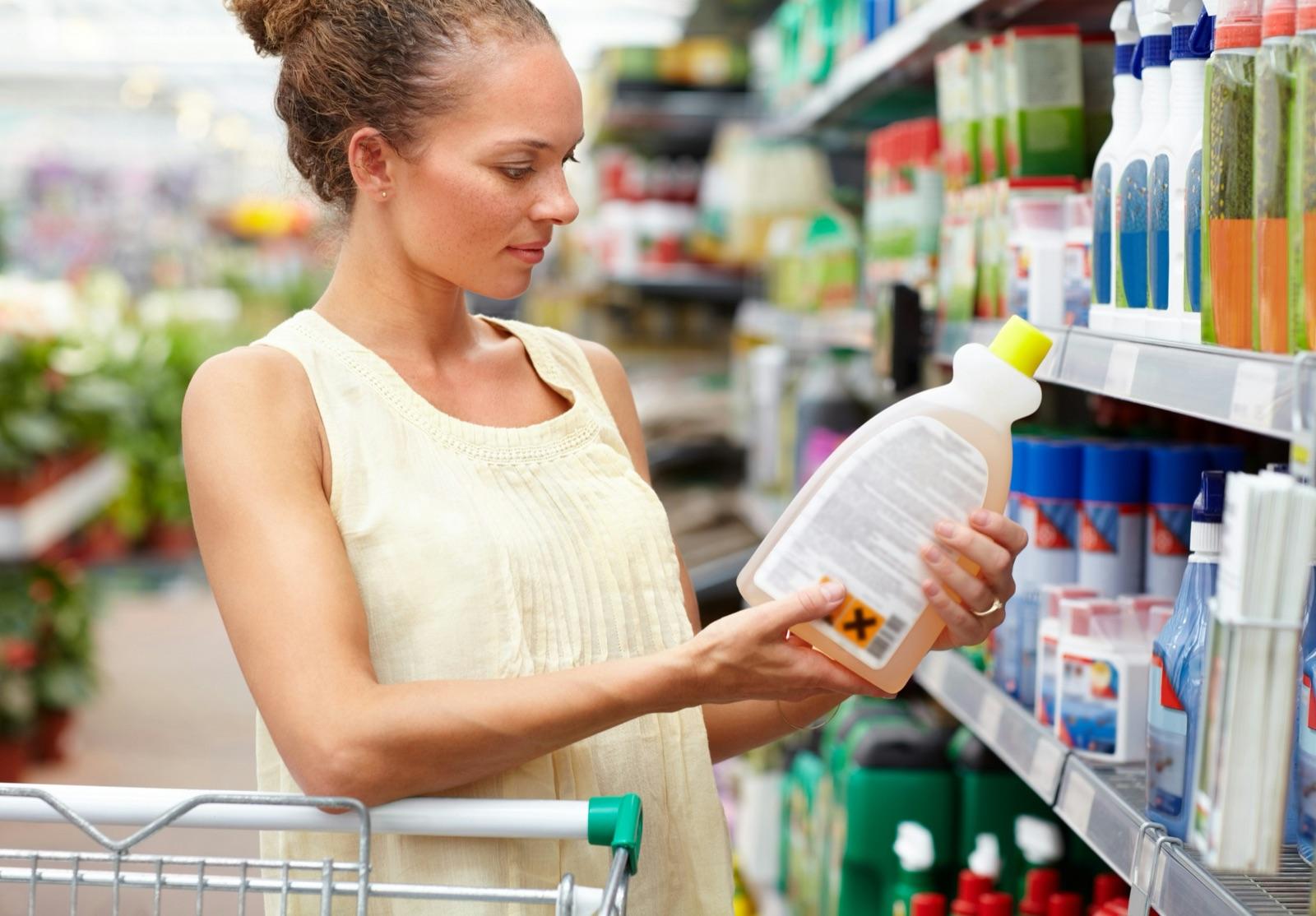
04 / LABELSSpotting dyes on a label.
- US labels — “Red 40”, “FD&C Yellow No. 5” or, for the lake form of a colour, “Yellow 6 Lake”. The “FD&C” prefix and “No.” are optional.
- EU labels — the E number or name, plus the warning sentence if it’s one of the six.
- Cosmetics — the CI number, such as CI 16035 or CI 19140. The EU warning applies only to food.
Front-of-pack claims like “no artificial colours” are worth checking against the ingredient list for the names above.
05 / VERDICTThe bottom line.
Caution for the warning-label dyes, Avoid for Red 3.
Red 40, Yellow 5 and Yellow 6 are rated Caution in food because the EU requires a warning — not because they’ve been shown to cause harm at permitted levels. Red 3 is Avoid because the US has revoked it for food. Blue 1 is Fair. If your child seems sensitive, cutting brightly coloured foods is a low-cost experiment; talk to your doctor before drawing conclusions about attention or behaviour.
06 / SOURCESSources.
- McCann et al., The Lancet (2007) — Food additives and hyperactive behaviour in 3-year-old and 8/9-year-old children.
- Regulation (EC) No 1333/2008, Annex V — the warning label; Article 35 — applies from 20 July 2010.
- EFSA re-evaluations: Allura Red AC (2009), Tartrazine (2009), Sunset Yellow FCF (2014), Erythrosine (2011), Brilliant Blue FCF (2010).
- Health Canada — List of Permitted Colouring Agents.
- US FDA — FD&C Red No. 3.
- US FDA — HHS, FDA to phase out petroleum-based synthetic dyes (April 22, 2025).
- 21 CFR 101.22(k) — declaring colours on US food labels; 21 CFR 74.340 — FD&C Red No. 40.